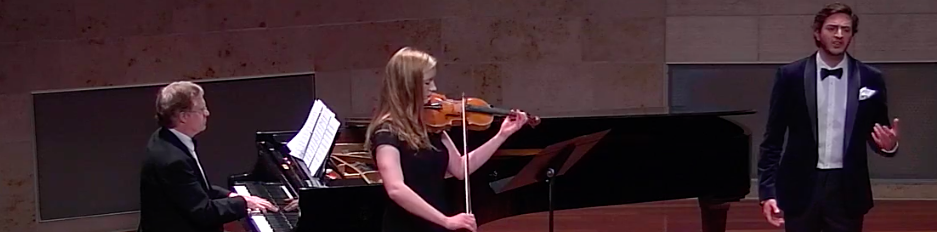
God doesn’t care which E you play

The past two weeks I’ve been thinking a lot about what it means to live a good life. I’ve been thinking about it because my grandfather died. Death of a loved one, reminds us that death is not an abstract concept but rather a concrete experience in which one person that was very much there the day before is no longer there at all. It feels a bit the way an earthquake does. We take for granted that the ground does not move, and yet the ground moves. Reality is always changing for us, and we cannot fully predict what will happen next. I thought I would say goodbye to my grandpa, knowing that it was goodbye.  As it is, I gave him a rather cheery hug in August and that was the last time I saw him. There is so, so much we don’t know and can’t know about the future. I do believe in God, and I do believe that the final V-I cadence of our existence isn’t on our funeral day. However, the tricky thing about life is that we don’t have the score. We don’t know who comes in next, and we don’t always know who is playing harmony with us, we only have our own part, and sometimes we even have to make that up as we go. We can ask God questions, but that certainly doesn’t guarantee answers. Yesterday, in orchestra rehearsal, the conductor asked us to turn around our stands, to look around, and to play with each other. That felt more like life, than symphony playing usually ever does for me. The only way we get through life, and the only real way to get through a symphony, is by looking up and actually listening to the people around us. How do we survive the abstract? The unknown? The ambiguous? The unexpected? The shocking? The scary? By holding on to each other. It’s so tempting to just trudge along and play our own part the way we think it ought to be played, without regard for how others come to play. But, that’s not a symphony and that’s not life. In reflecting on my grandfather’s life, I’ve been thinking about his work-life balance. He worked exceptionally hard, and had such an incredible career. He made a difference through his diligence that can only truly be measured by what someone said in his retirement video: “people for generations will be drinking water out of projects that Lee Wimmer built.” He would have lived a wonderful and important life if that were all we could say. But that was only one half of Papa, and it’s not even the half I really knew. He was a shy man, and used his words sparingly. But he showed his love through actions, and he did those actions everyday. When I stayed with my Papa and Gram after my mission I remember thinking that I would be lucky if I could find a man anywhere near as good as him to marry. My grandmother had not been diagnosed with Alzheimer’s yet, but she had many of the symptoms, and her body had started deteriorating before his. He took care of her with exceptional love and exceptional service every single day. He cooked for her, he cleaned the house, he did the laundry, and he did this even before he retired. He was doing the work of two people, and he was doing it with patience like none I had ever seen. He took care of me when I visited, he took care of my siblings and cousins when they visited, he took care of my mom and my aunt and uncle and their spouses. He was always taking care of everyone. Of course, he changed throughout his life, and I think he was the most service oriented in that period, but I will never ever forget the example he gave for me of service and love. He taught me that you never have to say “I love you” for someone to know how much you love them. If you give someone a kiss on the cheek after doing a thousand small and simple tasks for them, it says the same thing. My grandpa was an “As You Wish” man. Just like Westley in the Princess Bride, every small task he did was an expression of love. Papa taught me that love is not one big proposal. Love is an everyday experience of service.

Earlier this week, my teacher Dimitri gave us a lesson in studio class about intonation. He taught us that there are three different kinds of intonation— Just, Pythagorean (melodic), and Well-Tempered— and that different kinds of intonation are right for different kinds of music. I’d heard the concept before (from him), but it hit me differently this time. I think that living a good life is a bit like being in tune. We might think there is only one way to be in tune, but there are actually a few different options. My Papa was at certain times very actively involved in church, and other times not. At one point he drank lots of Coca Cola and ate lots of chocolate, and at another point he ate tons of salad and barely any bread. But he was a good man the whole time. I think sometimes we get so stuck in the little minutia of what we think it means to be a good person, that we forget what really matters. I think what really matters at the end of the day, what God would care about the most, is how we treat people. I think that if we are “As You Wish” people, like my grandpa, we’re good people. We might not be perfect people, but we’re still good. I think God is like the audience member that cares more about where your heart is than whether you play your E in the just intonation style or in the Pythagorean style. That being said, I think being able to play with just intonation and being able to live a very clean life are both important. However, I think remembering that the greatest commandment is the one to love each other, and that the most important thing we can do with music is touch people’s hearts is so so important.

In other words, let’s forgive ourselves and remember that life is about playing together with heart, rather than playing perfectly.

300-500 words on your musical dreams

TO SUM UP YOUR LIFE’S DREAMS IN 300-500 WORDS IS SUCH A STRESSFUL EXPERIENCE, and it took me like 2.5 months to finally be able to do it. This might not be the most beautiful prose, but it comes straight from the heart and I thought it was worth sharing. To all my friends in classical music, waking up every day and working incredibly hard to become great artists, just know that your work is ALREADY worthwhile (at least for me) and that if you continue on this path you will truly make an irreplacable mark on the world around you. I love you all so much!

Four years at conservatory and four years at an arts high school have taught me that becoming a great musician is an Olympic feat. It takes sacrifice every single day. If you want to become truly great, you must be willing to put in the focused time. You must be willing to practice etudes in the morning instead of sleeping in, to rehearse on Friday night instead of going on a date, to spend your summers at festivals instead of out on the water. Being a classical musician is not a job, it is a lifestyle. Pamela Frank once said, when asked what her religion was, that it was music. If we were making these sacrifices simply to win competitions or to achieve fame, we wouldn’t make them. Every time I make a sacrifice for music, I make it because I truly believe that music can change the world. Life is exceptionally difficult, for everyone. If it hasn’t been hard yet, eventually it will be. I’ve battled skin cancer and endometriosis. I’ve had anxiety and panic and depression. I have watched the people I love struggle with mental and physical illnesses and I have tried to hold those people up and care for them the best that I can. I have failed and I have been disappointed. I’ve been in love, and I’ve had my heart broken. I have knelt on the ground crying and begging God to change my world. Every answer to these prayers has come in the shape of notes. Music reminds me every day, and in every concert, that life is beautiful.The resolution is always worth the tension. The triumph is always worth the struggle. The joy is always worth the grief. Life is exceptionally difficult, but it is also exceptionally beautiful. Classical music is also exceptionally difficult, but exceptionally beautiful. The goal that gets me up and into the practice room every day, is that in every concert I will play for someone that is broken and that my playing will make that person feel whole. If I can heal hearts one concert at a time for the rest of my life, I will feel that I have achieved my purpose as a musician, as a violist, and as a human being.

GRATITUDE IS SEEING THE FLOWERS IN THE RAIN

The past few days have been tricky. When I wrote about joy being life’s most beautiful refrain, I expressed that I was in perfect health. It’s funny how quickly that can go from being true to being untrue. I had an abnormal growth on my face, and I wanted to get it checked out. It required a surgery that was supposed to be super duper minor, but ended up disrupting my productivity and my nutrition and my sleep and my attractiveness for 48 hours +. I’ve experienced all the emotions. I’ve laughed, I’ve cried, I’ve gotten mad, I’ve asked God why. My most common prayer is “WHY.” When I grew up, I always asked my parents WHY. I always wanted to understand WHY. In a way, always asking why has made me a more intelligent and more empathetic person, but I’m sure the question gets tiring for those who have heard it most. The WHY always seems to be different. This time I think the WHY was to get me to appreciate my everyday life more. I’ve been getting a lot of inspiring input on gratitude from some close friends, from my therapist, from church activities; and I was really trying to put it into action. This surgery felt like a test. Could I be grateful when my lip was full of blood and bruised and making me look like a blowfish? Could I be grateful when I felt ugly? Could I be grateful when I was in pain? Could I be grateful when I was anxious and afraid that the complications would be worse than I had imagined? The answer to all of these questions was not always yes. I have looked in the mirror and cried. I have cried when my pain meds wore off in the middle of the night at 4 am. I cried when I went to the dr for the second time and they still couldn’t fix it. I have cried a lot. BUT I have also been reminded of the infinitely large amount of blessings I have that have not changed. My mouth is huge, my face is puffy, I can barely stick a straw inside my mouth to get some calories inside of my body, I can’t practice without bleeding, and every time I look in the mirror I get concerned that if they can’t fix this no one will ever love my face. It’s been A TIME.

BUT I have been so loved.

One roommate went with me to the dr, and another helped me cut food into small pieces so I could take my meds without getting sick.

My closest friend (and roommate) Yijin has helped me find inspiring and joyous songs every day to keep up my spirits, and has checked on me practically every hour of every day, whether she was home or at school. She always had a way to make me smile or laugh, even when I was on the verge of tears, and we have had some of our funniest moments in the past 2 days.

My mother called me several times, and even called my dr. She laughed at all my jokes, she supported me, she gave me ideas about how to handle the problem, and validated that staying in bed and watching Netflix would actually be a perfectly normal and ok response to having complications to a surgery (even a minor one). She has sent her love and support and heart emojis to me and even offered to fly me home.

My sister sent me some amazing gifs and expressions of love from instagram and I’ve received a lots of messages of support from social media and even from email. I moved a recording session, and even the recording engineer expressed a level of care I had not dreamed was even possible from someone I have not even met.

Friends have come to check on me in my apartment even when I’ve said I’m too ugly to see them, and people have given me the kindest and most necessary of hugs.

I’ve also been reminded how much I take for granted. I always hate on my face. I’m so mean to my face. And to be honest, after this whole experience, I’ve realized that my face is actually pretty ok on an average day. I actually CAN’T WAIT to see my normal face again. When I was having trouble finding things to be grateful for, I put up a new white board of “things I’m grateful for today” and the board has been too small everyday for everything that I have found to be grateful for.

I think having gratitude in difficult circumstances is not about enjoying the bad things or appreciating them, or even understanding the WHY. It’s not about seeing the bad things as part of a beautiful circle of life. Those sorts of lessons are never understood in the moment, and perhaps they’re not supposed to be. I think having gratitude in difficult circumstances is about seeing the wonderful amongst the terrible. It’s about seeing the small patches of flowers that pop up on rainy days. In the words of Anne Frank, who suffered more than I could possibly imagine or understand, gratitude is “thinking of all the beauty still around you and being happy.” Life is not perfect, but life IS beautiful. Life is especially beautiful, because of the beautiful people we meet that touch our lives.

To all the beautiful people in my life, thank you so much. You remind me that “the sun will (always) come out tomorrow.” (Annie)

Change your posture, Change your life

I had a friend once tell me: “I believe that if you change your posture, you will change your life.” This statement felt huge and bold and terrifying, and quite possibly true. I guess I didn’t feel like changing my life at the time though, because at that time I didn’t change my posture. Slouching had become a coping mechanism. Slouching made me shorter, and gave an illusion of squareness, which made me less uncomfortable with my body and made the world an easier place to live in. Slouching was how I dealt with negative body image for ten years. I could stand tall some days, if I’d spent a lot of time on my appearance and felt it was good enough to deserve the kind of attention I felt I received standing at my actual height. But, the majority of the time, slouching was my safe space. Over the past six months, I’ve been trying to fix my slouching for musical reasons– for career reasons. Yet still, it has been a struggle. Still some days I wake up and I don’t want to be tall, and I don’t want to be the shape I am, and I don’t want to be seen. But, I am a performer. I’m not a dancer or an actor, but my body is still part of the performance. I still have to use my body to make art. When I finally realized that, I realized that I would have to make peace with my body to become a better musician. How could I use my body in all the ways I needed to, if I was curling into a little turtle shell everyday? Turtles can’t play viola. I’m not even sure turtles could hold one. I discovered, after years and years of avoiding the truth, that I would have to leave my little slouching shell, in order to make beautiful music.

After making this life-changing realization that body image issues had been holding my music making back, I became quite interested in how body image affects career efficacy for women. I read a bunch of articles and studies, and what I began to realize is that body image/perception, for both men and women, has a major impact on social functioning and therefore career effectiveness. If someone feels more uncomfortable with their body, they’ll be less assertive and less competitive, and miss out on opportunities and lose competitive edge. It hit me intellectually and emotionally after about ten of these articles/studies, that the confidence many of my female friends and I are lacking in our bodies is impacting not only our self-confidence, but also our ability to play our instruments well, to perform well in concerts, to audition well, and to win jobs. This could be depressing, except for the fact that we can take this information to make the necessary changes we need to learn to love our bodies so that we can succeed.

When I was 18 years old, I was in love with one of my best friends. I told him, and he was gentle with that fact, and gentle with me, and even though it broke my heart that he couldn’t love me back– he took good care of me as a friend through one of the hardest times of my entire life. I once told him that I only felt beautiful when he told me I was. He said: “Why would you ever give me that power?” It only just occurred to me that what he really meant was: “Why would you give anyone else the power to decide whether you are beautiful or not?” The power to discover and appreciate our own beauty is within us, and only us. You can tell someone else they’re beautiful a thousand times and they still might not believe it. If we women are to step into our power and claim the success that we have the potential to achieve, we must learn to love and appreciate our own beauty, without dependence on others for validation.

Note:

Athleticism and appreciation of athletic skill has been linked to positive body image. However, overexercise has also been linked to negative body image. Positive nutrition can lead to positive body image, but it does not guarantee it. Also there are differing conclusions on what exactly constitutes positive nutrition. I didn’t give any specific instructions for how to love your body, because it is different for each person, and requires listening to yourself and your needs and your doctors. 🙂

Best article/study I found on Body Image and Career Efficacy (Sources cited list also includes excellent resources):

http://citeseerx.ist.psu.edu/viewdoc/download?doi=10.1.1.581.9478&rep=rep1&type=pdf

FLOOR IT

Sunday afternoon, I found myself walking onto a stage, in my regular day clothes with some friends from school and a large gathering of older ladies and gentleman. I had come to listen to a concert, rather than be in one, and so I said jokingly to one of my friends that: “This is more than I signed up for. This is more than I was ready for. I am not emotionally prepared for this.” Prior to standing up, I’d been fully enjoying and appreciating some great new music, but trying to pretend as though I wasn’t excited about it. I had no desire to be particularly seen or heard, I simply wanted to listen to great music, with my coat on and my arms folded around myself like a shield. I had been prepared for that sacred and somewhat solitary activity of listening to a concert, but I had not prepared to be a participator.

The organizer of the concert and the composer of the new works, Nick Platoff, is a fairly open and unafraid person. He is who he is, and he’s not afraid of being seen and heard. In fact, the only reason I was in the concert in the first place, is because I had seen his extremely genuine personality on his instagram stories, and I had thought to myself that I definitely wanted to hear what kind of music he was going to make. It became evident to me during the concert that he wanted everyone in the audience to feel a little bit freer. He began interacting with the audience from the very beginning, even though the majority of the audience was not ready to reciprocate his energy and joy at first. I, perhaps, least of all. The first half of the concert warmed up our hearts, with some great repertoire for brass quintet. This felt a lot like the regular church-like experience of classical concert-attendance, with the exception that there was some little interaction in between each piece. But I was still in my seat, I was still in my coat, I still had my arms folded around myself, and I still was constantly wearing my professor face. I tried to keep that persona for the second half of the concert but I couldn’t. It was impossible to listen to Nick’s music, and not smile. I was trying to intellectually piece together and understand all of his structural choices, his harmonies, his lyrics (and Abstract Rude’s lyrics in their awesome collaboration), his voice, the brass quintet playing and the sound effects. BUT, what I felt in the end, was an opening up of the heart.

I was particularly struck by a piece he wrote in memory of his grandfather. The piece included a recording of his cousin talking about the experience of learning to drive with their grandfather. Right away, I was paying attention, because I haven’t learned to drive. I am 25 years old, and I can’t drive. And to be honest, I’m straight up terrified of driving. For context, the first time I drove, at the age of 21, I ran the car into the side of the road and got a flat tire, and I haven’t done much driving since. Along with the recording, the brass players were playing beautiful and interesting harmonies, while Nick sang “Don’t look at me with tears in your eyes, cause I’m still alive…” He also included some sounds of cicadas, because of how he had been remembering his grandfather in a forest. It was a huge sonic experience , and there were so many layers to unpeel. I’m sure I could sit down with the piece and do a score study and write a nice long essay about it. BUT, the main take away, the part that hit me the hardest was when the cousin said that driving became a life lesson when his grandfather said “If you’re going to do something, do it with distinction. FLOOR IT.” Nick had at that point included the sound of a revving engine. At this point, I was smiling ear to ear and shaking my head. Flooring it, is exactly opposite to my life experience in every way, but this piece made me feel like maybe it’d be nice if it wasn’t. I’ve written a lot about fear, and bravery, and how courage is not the absence of fear but the decision that something is more important than fear. But there’s a lot of things that I haven’t decided are important enough to overcome my fears, and that piece made me truly reconsider a lot of those fears. What would I throw my energy into, if I wasn’t afraid of failing? If I wasn’t afraid of being poorly received by audiences or readers or loved ones? What would I do, if I could do anything? So much. I would do so, so many things I don’t do. I would compose more, and actually perform my compositions for people. I would actually publish my poetry and my works of fiction. I would play forte without turning red from embarrassment. I would do the concerto competition.

Right at the moment when I was considering what exactly I would do with my life, if I was the kind of person that “floored it”, Nick asked everybody to join them on stage for the last piece. To be honest, if the pieces had been in a different order, I probably would have just kinda quietly ran away and not gone up on stage. BUT, I had all this adrenaline from the piece before and so I went up. And, I was still kind of embarrassed, I was still kind of awkward and quirky and not fully aware of how to use all of my limbs as we clapped and sang and swayed on stage, but I was having a great time. I was having the time of my life. I was remembering what it felt like to be a kid, and to just genuinely enjoy the experience of music making, without being concerned if it was perfect. I left that concert feeling lighter, feeling freer, feeling that I could do anything. Feeling that maybe, just maybe I could….

FLOOR IT.

Joy: life’s most beautiful refrain

I have three scars: one on my right shoulder, and two on my stomach under my belly button. Most days, I actually forget about them and the experiences they have immortalized upon me. But some days, while I’m examining the efficiency of my bow arm in the mirror, I see the thick purplish pink line on the back of my shoulder, and I remember. Some days, when I’m putting on my gym shorts, I look down and I see the thin little lines, and I remember. Life was so hard at one point, and life is so ridiculously easy now in comparison. Would I know my life is easy now if I didn’t have that comparison to make? Would I understand how many reasons I have to be thankful and joyful and at peace, if I didn’t have that comparison to make? One day last week I woke up and I thought to myself that I must be the luckiest woman in the entire world. I felt so happy. I didn’t even have a particular reason! I just woke up feeling super, super satisfied with my life. For those who know me well, that is not usually my first reaction to the morning. (Haha) I was contemplating on why I felt so happy, so satisfied, so content with my life. Then, as I was running at the gym, it struck me. This is one of the happiest periods of my life, because after going through the thick of it, I’m finally NOT going through the thick of it anymore. I don’t wake up with pain, and I used to wake up with pain everyday. I don’t wake up with uncontrollable anxiety, and I used to wake up with uncontrollable anxiety. For the first time in many years, both my body and my mind feel healthy. This is something I used to take for granted: physical and mental health. I never will again. Do I feel perfectly happy everyday? No. Am I immune from colds or the flu? No. But do I understand that I have it pretty dang good and I’m pretty dang privileged and lucky and blessed? Yes, 110% yes.

I’ve been thinking a lot about how pain has helped me to understand joy, because I’ve been feeling a lot of joy lately, and I think my joy is richer than it ever was before. Last week in chamber class, it finally all clicked in my head. The concepts of “tension” and “release” are discussed so much in chamber class, and at conservatory in general, that it often becomes humorous to many of us. However,  when for the millionth time someone said that if you don’t build up enough tension the release is not as satisfying or as powerful, I finally realized why pain and struggle help us understand and feel joy in a deeper and more profound way. Just as tension does not only teach us about tension, pain does not only teach us about pain. Tension teaches us what release is, and pain teaches us what joy is. We understand and appreciate the best of life, after having experienced the worst of it. There is “opposition in all things”, and without that opposition, life’s climaxes would not be fully enjoyed and understood. We need the hero’s journey to understand true joy and happiness. 

Will I be this happy for the entire year? For the next five years? Only for this semester? There is no way to truly tell. But what I’ve finally decided is that just as you can enjoy a beautiful and triumphant cadence without worrying about whether it is the end of the piece or the beginning of the most dissonant section, you can enjoy the happy seasons of life without worrying if they will end soon. I’ve also learned, most important of all, that struggle is not something to be ashamed of or afraid of. It is simply a part of life. We all end up with scars, in one way or another. But what matters is how we live on after the healing, and what we learn from the journey along the way.

I think the human relationship with joy can be explained very well using T.S. Eliot’s words:

“We shall not cease from exploration and the end of all our exploring will be to arrive where we started and know the place for the first time.”

Each time we return to joy, it is a new place; just as each refrain of the primary theme in a symphony or a sonata or a quartet is played differently depending on what occurred in the development. Each occurrence of joy is just as beautiful as every soaring and soul-filled melody.

(Scars described are from previous battles with skin cancer and endometriosis, which thanks to modern medicine, good health insurance, and extremely wonderful and generous parents, I have been able to put behind me)

LOS ZAPATOS NO SON TAN IMPORTANTE COMO EL AMOR

About seven months ago, I began a quest. I was determined to figure out how to become exceptional at conflict resolution. For five out of those seven months I felt like I was getting nowhere, and that maybe my quest was a fruitless search for a nonexistent paradise. It felt a lot like when you’ve been playing the same passage for hours and hours and hours, and the passage seems unsolvable and unlovable and completely lacking in beauty and meaning. Then, as often happens in such moments of despair, I peered out and saw a glimmer of light at the end of my long dark tunnel. At the John F. Kennedy airport, I saw a book entitled “MINDFUL LISTENING” by the Harvard Business Press. It was a tiny little white book with gold letters on the front. I didn’t even know what it was about but I bought 6 of them. I figured maybe they could be gifts for my chamber mates at Borromeo Music Festival. I had no idea that I was about to read something that would change my life forever. (Yes, I do realize that this 100% sounds like a commercial for this book….it isn’t….) After miraculously getting my two instruments on the plane, and settling in for my long flight, I opened up my book and took out my pen and prepared myself to learn something. What I did not prepare myself for was how I was about to be humbled. Less than ten minutes into the flight I read the following sentence: “Good listeners are trying to help, not trying to win.” It was at that moment that I realized what had been wrong with my quest. When my search began, I hadn’t just been looking for a way to resolve conflicts. I had been looking for how to get people to see that I was right. I wanted to do it kindly of course, but I still thought that I was undeniably right. This is why my quest had been getting literally nowhere.


Have you ever worked with someone that refused to change their tempo in a performance because it was the “right” tempo, even when clearly it wasn’t working out for someone (or everyone else) in the group? ….Well when I read the line: “Good listeners are trying to help, not trying to win” I recognized that I had been doing the same exact thing, but in conversations about rehearsal scheduling, time management, and group goals. I even recognized that I had been doing that in other deeply important relationships. I had been so determined I was right, that I wasn’t allowing for compromise, and because of that I was stagnating my growth and the growth of my relationships. Relationships are built on compromise. They literally don’t exist without it. The chance of any two people wanting the exact same things 100% of the time is almost 0.


Is it easier to play alone than to play in a group? Yes. Is it easier to work independently than to work in a partnership or a family? Yes.


But will a solo ever sound like a quartet?

Will a single person ever feel like a family?


NO.


Once while I was serving my Mormon mission, I told a couple that was struggling that

LOS ZAPATOS NO SON TAN IMPORTANTE COMO EL AMOR.

(SHOES ARE NOT MORE IMPORTANT THAN LOVE)

I pointed out that the things we fight about as coworkers, as friends, as couples, as families— they are often small things. I gave the example of a couple fighting over where to put shoes in the house. Of course, we need to talk about these things. The shoes need an organized place, the kids need a good school to go to, the roommates need to define boundaries, the couple needs to talk over behaviors that make them feel good and behaviors that don’t make them feel good, the string quartet needs to discuss about 5,000,000 technical and musical decisions to make one movement sound the way they’d like it to. But, is love not more important? Can these decisions not be made in love? Is there not always a loving way to have a discussion?


Love is nothing without listening, and listening is nothing without being able to admit that we might be and very well could be wrong. I am the kind of person that likes to have a plan. I like to know what’s happening in the next fifteen minutes, in the next three hours, in the next five days, and I used to make a ten year plan every year in January. I like to have a complete picture of how things are going to go. What I’ve finally realized is that listening means letting go of the plan. Listening means understanding that life doesn’t come with a trailer. You never know what’s coming next. Listening to your loved ones means knowing that you might have to write your planner in pencil, and that some days you might have to completely rewrite the plan. Listening to the musicians in your chamber group means knowing that you might practice the same section twelve hundred times the same exact way, and play it differently in concert— and that doesn’t mean it’s wrong. Resolving conflicts requires being able to accept that life is unpredictable and that people are unpredictable and that you won’t always have the answers to everything. The answer to all of my searching for how to be an exceptional conflict resolver and an exceptional listener is scary. It requires me to be able to let go, which I’m exceptionally bad at. But if I’ve learned anything this summer it’s that when we let go, the strings of our lives resonate openly, and we can fill the world with a more beautiful song.


So my dears, Let’s not fight over shoes PORQUE LOS ZAPATOS NO SON TAN IMPORTANTE COMO EL AMOR.

The Artistry of Living

In my viola lesson today, Pei Ling asked me what my ideas about the emotional content and character of the 1st movement of the Walton Concerto were, or what I felt them to be. I think she was surprised by how clear some of my ideas were, considering none of them were really showing in my playing. She looked at me quizzically and I explained that I can play it more yearningly, more regretfully, more nostalgically, more bitterly, more furiously; but that I don’t feel I deserve to do that, until I’ve fixed all the technical things. In other words, I believe that I am not worthy of musical expression unless my technique is perfect. The moment I said that, the silliness of it struck me. If I waited until my Playing was technically perfect (until no one could complain about any single solitary note or vibrato or bow stroke) to play with musical expression and emotional passion, would I ever play expressively at all?

Of course, my technical goals remain unchanged. However, I have decided that bravery comes from the very possibility of failure. Bravery is facing the risk that I could play the note just a hair out of tune, and playing it forte anyways. Bravery is facing the risk that I could miss a shift in a fast passage, and taking it at a brisk tempo anyways. Bravery is facing the risk that my interpretation might not be perceived as correct by a critic and doing it my own unique way anyways. True artists are brave. True artists don’t play safe every day. If I want to make great music, I’ve got to stop playing it safe.

Usually when I make music epiphanies I also make life epiphanies and here is the life epiphany this one has helped me make. The past five years have been an blossoming out of a very safely led life. In my high school and early young adult years, I took very few social or personal risks. I just wanted to do everything “right.” I wanted to be the perfect daughter, the perfect sister, the perfect student, the perfect violinist, the perfect chamber musician, the perfect friend, the perfect Mormon girl, and of course I wanted to look like a Russian supermodel. Those goals aren’t necessarily bad goals BUT what was bad was that I believed I didn’t deserve to live my life bravely before becoming that person. I had a small circle of very good friends, but I was bad at meeting new people and making connections on my own. I had a hard time speaking my mind. I had a hard time being open or generous or vulnerable. I never, ever flirted with anyone. I lived my life in a pianísimo dynamic.

Pianísimo can be beautiful. But some of the most wonderful things in life require bravery. Every time I choose to be vulnerable enough to let people into my life it requires bravery. Every time I tell the deepest truths about myself it requires bravery. Every time I offer to help someone in need it requires bravery. Every time I take a personal or professional change in direction it requires bravery. The best and most beautiful things in my life really have been on the other side of fear. But I’m still afraid, and I still make decisions based on fear.

When I’m afraid of doing something that could have a positive impact, I remember these two quotes:

“Our opportunities to give of ourselves are indeed limitless, but they are also perishable. There are hearts to gladden. There are kind words to say. There are gifts to be given. There are deeds to be done.” – Thomas S Monson

“If not me, who? If not now, when?” -Hillel

If we wait until we’re perfect to live our lives bravely in forte, we’ll wait forever. If we wait until we’re flawless to give people our heart, we’ll live our lives alone. It takes courage (and humility) to play an instrument with deep emotional conviction, knowing you could mess it up. It takes even more courage (and humility) to live a life of deep emotional conviction, knowing you could mess it up. But both are exceptionally worth it.

The artistry of living is worth overcoming all of our fears.

Smiling With the Drone Still On

Recently, I had a slight crisis about my intonation. I realized that while I don’t have cringeworthy intonation, and while many non-musicians may assume that I am in tune most (Or all of the time), I’m actually not sure I’m EVER in tune– at least not perfectly. After this realization, I started practicing almost everything with a drone (Or a pedal note) underneath. Scales, etudes, concertos, sonatas, Bach and my chamber music parts. Let me tell you, listening to a drone 5-7 hours/day every day is a really good way to feel like you have no idea how to play your instrument. However, I tried taking the drone away, and my ear had still learned a new way to listen. One of the trickiest things about getting better at practicing is that it means we hear more mistakes. What we sometimes forget though is that if we are hearing more mistakes, we are fixing more mistakes.

I have been working on hearing my mistakes, and working patiently through them, without judgement or anger towards myself. After all, if I wait until I play perfectly in tune to enjoy my own music, I may wait until I’m in a retirement home or have passed from this life. I say that actually without humor, Yo Yo Ma used this anecdote:

A cellist walks on a beach and picks up a bottle. A genie pops out and says, “I give you two wishes.” 

The cellist says: “Wow, I’d like to have world peace.” 

The genie thinks for a second and says, 

“That’s too hard! What’s your second wish?”

The cellist says, “Well, I’m turning 60 and I want to play in tune.” 

The genie thinks for a second and says, “What was your first wish again?” 

If Yo Yo Ma still works on intonation, we’re all going to have to work on intonation for the rest of our lives. What we can learn from him though is he didn’t wait to feel his intonation was perfect to pursue music as a career, to create interesting chamber ensembles, to use music as a means for sharing messages of love and peace and understanding with the world, and in short to change the world quite measurably with his music.

Yes, of course, he’s also one of the most exceptional cellists to ever live. But maybe he’s so good because he is patient with himself in the process, and because he finds ways to laugh. This summer I’m trying to learn some very difficult viola repertoire: the Walton Concerto, Bach’s 3rd Partita transcribed, and a sonata (Rochberg or Rebecca Clarke). I’m taking on a lot as someone that’s new to the viola, and it’s easy to get impatient with myself. But what I’ve been learning is that the kinder we are with ourselves as we are improving, and the more slowly and patiently we work, the faster we actually improve. Angrily and hastily scrubbing away at the viola or the violin gets me literally nowhere, and eventually ends in tears.

Today I was thinking about the things I want to change about myself as a person. I want to be more understanding and empathetic, more patient, more loving, more responsible, more diligent, more intelligent, better with money, better with my words… the list goes on. But maybe getting better as a person is just like practicing with a drone for intonation… it takes patience.

This morning it occurred to me that God wants me to be able to find joy now– in my present moment–just as I am. God doesn’t want me to wait until I can play perfectly in tune or elegantly love everyone to be happy. Nor do I want to wait for such a far off day of perfection ! There’s beautiful things I am doing already that I can be proud of. There’s people I am helping. There are phrases that are lovely. Life is beautiful already. And so am I. And so are YOU.

We’re not perfect! But beautiful doesn’t have to be perfect. In the words of Leonard Cohen:

“There is a crack in everything. That’s how the light gets in.”

The Rose Colored Glasses of Hope

Pei Ling: “Can you tell when you sound good?”

Me: “Sometimes.”

Pei Ling: “Pay attention to those times, because you’ll learn the most from them. Think about what you’re doing in those beautiful moments, because then you’ll be able to replicate it over and over until you sound that good all the time.”

I’m not alone in saying that when I practice, I’m looking for when I sound BAD. I’m looking for what’s WRONG. I’m searching for MISTAKES. And to be honest, just like most anyone studying classical music, it takes me about two seconds to find errors and to find them EVERYWHERE. To be fair, this is in a way a necessary evil. It works. The better we get at playing, the easier it is for us to hear and therefore CORRECT mistakes. Then, the better and quicker we get at correcting mistakes, the faster we progress towards the “flawless” ideal.

But do we hear when we sound GOOD?

Do we EVER think we sound good?

Do we ever think we have improved?

Do we ever think we sound better ?

Or have we learned to see our playing in the reverse of rose colored glasses– to see nothing resembling beauty at all ?

Several recent studies have proven that musicians suffer shocking blows to mental health as a group. 73% of independent musicians experience mental health issues including depression, anxiety, panic disorders, eating disorders, and substance abuse. The number is even higher for musicians ages 18-25 (80%). ** if you need full stats, I will post links at bottom

I had a good friend tell me once that being depressed was like seeing your life through a tiny microscope on the most awful and ugly parts. He noted that if one couldn’t look up from such a microscopic vision– they would be incapable of seeing all the beautiful things surrounding them that were outside of the microscope’s vision.

As musicians, we’ve been taught how to use a microscope to examine and cure the flaws in our playing. But sometimes, we need to remember to look up from the microscope and see the bigger picture. Sometimes, as Pei Ling suggested, we might even need to replace our microscope with some rose colored glasses.

All that being said, it’s not just musicians that experience mental health issues of course, and even with musicians sometimes music is not the root cause of those problems. But Pei-Ling’s question can apply to our lives as well. Can we tell when we are good? Can we tell when we are helpful? When we are smart? when we are hard working? when we are a good friend? a good partner? a good family member? In short, can we tell when we are making the world a better place? If we are constantly seeing our contribution to society, or to the lives of those we love, in a critical manner, than we are missing an opportunity to grow by recognizing what we are doing RIGHT. Similarly, if we are too focused on aspects of our appearance or our personality that we may perceive as unattractive, we may never realize our charming qualities and be able to use those towards our advantage. More importantly, we may forget that physical attractiveness and even personability and charm are fading beauties in comparison to the treasures of intelligence, skill, wit, compassion, generosity, empathy and the ability to connect on a deeper level.

I am not by any means someone that thinks we should throw around insensitive phrases like “just be happy” or “don’t stress out so much.” But, I do believe, that if we choose to take the slow and conscious effort of lifting our eyes from the microscope of criticism and towards the rose colored glasses of hope — we will be able to see all the wonderful things we are capable of accomplishing– and in so doing, we will help make the world a healthier and happier place.

In her famous song “La Vie En Rose”, Edith Piaf is happy for such a simple reason. She is happy because a man that she cares about is holding her and whispering kind words in her ear. She’s not seeing everything in lovely colors because she plays Paganini perfectly, or because she is a winner of the Nobel Prize. It is also noteworthy that the song does not mention the full nature of their relationship, and there is actually no proof based on the song that it was longer than a fling. Edith Piaf was happy simply because something good was happening to her in that very moment. If she’d been focused on that microscope, maybe she’d have missed the moment. Maybe we miss that moment all the time… and maybe, we don’t have to. Maybe we too can just look up into the eyes of the ones we care about, forget about the notes we can’t play yet, and smile.

Disclaimer: Any mental health issue cannot be faced alone. If struggling with these issues, looking for the rose colored glasses should and can be done with the help of medical professionals. I myself have been receiving extremely helpful care from a psychiatrist the entire time I have been in SF/ at SFCM. I also received care previously in NYC and Boston. Without such care, I know I wouldn’t be where I am today. Seeking mental health assistance makes one stronger and helps in every aspect of one’s life.

https://www.helpmusicians.org.uk/assets/publications/files/can_music_make_you_sick_part_1-_pilot_survey_report_2019.pdf

https://www.opendemocracy.net/en/transformation/why-we-should-all-be-concerned-about-musicians-mental-health/

https://www.google.com/amp/s/www.nytimes.com/2018/01/26/arts/music/musicians-mental-health.amp.html

https://www.classicfm.com/music-news/musicians-eating-disorders/

https://www.google.com/amp/s/neurosciencenews.com/musicians-eating-disorders-7156/amp/

https://www.google.com/amp/s/www.billboard.com/amp/articles/news/8509490/mental-illness-independent-musicians-study-73-percent-record-union

https://www.google.com/amp/s/www.grammy.com/musicares/news/report-musicians-more-likely-struggle-mental-health-substance-abuse%3famp