
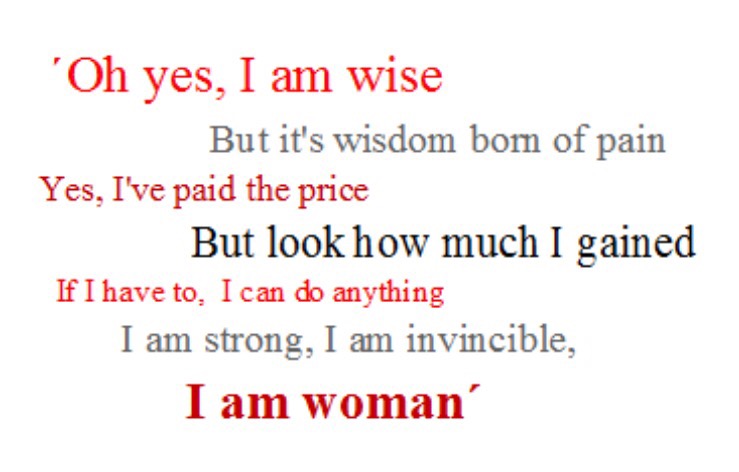
Lyrics: Helen Reddy
When it was decided that a family project for the summer would be participating in a high intensity personal training regimen twice a week, I was anxious. Not because I don’t enjoy exercise, not because I don’t love a challenge– but because I have a condition that causes lower abdominal pain of varying degrees almost every single day of my life. The last appointment I had with my specialist from the UCSF Women’s Health Center they informed me that this condition, which they believe to be endometriosis (no official diagnosis can be made without surgery), has caused damage to the muscles of my pelvic floor along with the muscles and nerves on the lower left side of my abdomen. Needless to say, this makes squats and situps harder than they used to be. But I’ve always been determined and I’m not one to disappoint or back down on a goal and so I’ve done 4 Mission Fit personal training sessions these past two weeks.
I approached each session with a certain amount of trepidation and concern: fear even. But I also approached each session with the undeniable conviction that I will not let this disease defeat me. If I wake up with stomach pain worse than the pain I had the day before, that won’t stop me from practicing the violin, or doing my very best on my schoolwork, or from being the kindest person I can possibly be. It also won’t stop me from being strong physically. Or at least that is what I am hoping by participating in this physical fitness program, and by jogging on the days I don’t have Mission Fit.
What does all this have to do with feminism? Most people out there know that if someone says “you run like a girl”, they don’t mean it as a compliment unless they’re in charge of the always campaign “Like A Girl.” Out of all the ways men like to prove they’re superior to women, the physical is way up there. My trainer said that recently, he has more women that stick to his program than men. He chalked it up to us being “more willing to endure the pain.” I honestly feel that willingness to endure pain is based on our need to prove that we CAN. The more you have to prove, the more invested you will be– the more emotional energy you will have to throw into every punch, every squat, every plank, every situp. I have a lot to prove as a fighter of endometriosis. I have to prove to everyone, especially myself, that I can still function like a normal person–even participating in high intensity exercise.
Being a feminist having endometriosis, putting the specifics of exercise aside, is tricky because you feel that you are trying to prove your equality to men in the community, in the workplace, and in the home all whilst your female organs are making it hard for you to just handle average tasks. But, I guess that’s why partipating in a high intensity exercise program feels good even when it hurts. It feels like you’re saying “take that” to the endometriosis– the female disease that tries to prevent you from being the powerful woman you want to be.
Doctors everywhere say it’s incurable, that it’s chronic, and then give you some kind of birth control that brings down the pain maginally. There are a few that will give you the surgery you actually need, knowing well that you may have to come back for another operation in a few years. It’s so easy to lose hope with endometriosis, to give up the idea of being strong and powerful because the pain can leave you feeling so weak. But what I have decided is that I will never, ever stop fighting this disease and I will never give up hope. Every day that I put on my athletic gear (recently that’s 6/7 days) I remember that fact.
Basic description and statistics of endometriosis:
 This Sonorous Life